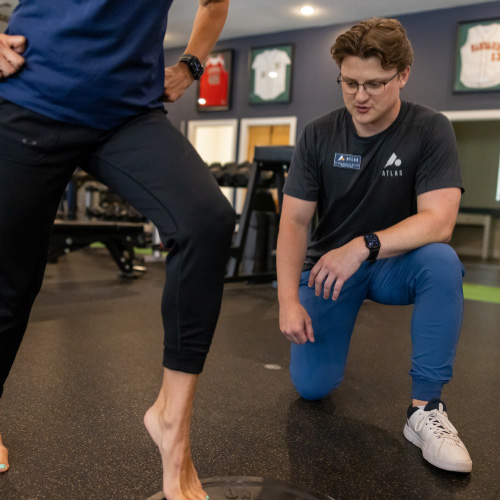
How to Tell—and What to Do Next
Most injuries don’t come from a single dramatic event. More often, it’s a misstep, a heavy lift, or a volume of repetitive activity that exceeds what your body is prepared to handle.
Pain, stiffness, and weakness can feel similar across injuries—but the underlying tissue involved, and how it should be managed, are different. Getting that distinction right early helps you recover more efficiently and avoid lingering issues.
At Atlas Physical Therapy, the focus isn’t just on reducing symptoms. We identify what’s limiting you—whether it’s tissue tolerance, joint stability, or load management—and build a plan to restore function and improve your body’s ability to handle stress. The goal is simple: get you back to what you do, with more confidence and capacity than before.
What’s the Difference?
Sprains
Sprains involve ligaments, the structures that stabilize your joints. They occur when a joint is pushed beyond its normal range, stretching or partially tearing the ligament.
Ankle sprains are the most common example, often happening when the foot rolls inward or outward.
Signs of a Sprain
- Pain around a joint
- Swelling and bruising
- Stiffness or a feeling of instability
How They’re Managed:
Initial protection matters, but too much rest can slow recovery. Ligaments need progressive, controlled loading to regain stability and coordination. The right movement—introduced at the right time—helps restore confidence in the joint and reduces the risk of reinjury.
Strains
Strains affect muscles or tendons, which connect muscle to bone. They occur when tissue is overloaded—either suddenly or over time.
Common examples include low back strains from lifting or hamstring strains during running or sport.
Commons Signs:
- Sharp or aching pain
- Tightness or cramping
- Weakness with movement
How They’re Managed:
Muscle and tendon tissue respond well to progressive loading. Complete rest often delays recovery. Gradually reintroducing strength and movement helps restore function, improve tissue quality, and reduce reinjury risk.
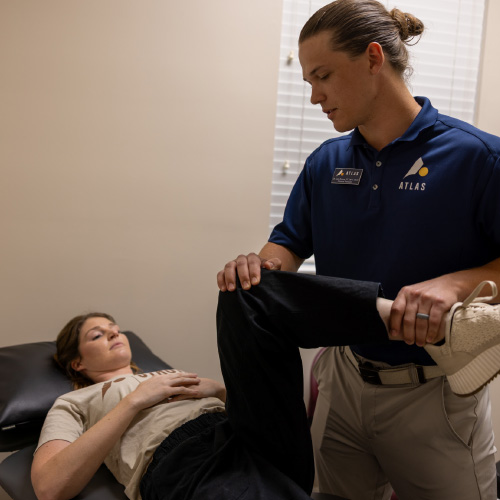
Overuse (Repetitive Stress) Injuries
Overuse injuries develop when repeated stress exceeds your body’s ability to recover and adapt. Instead of a single incident, they build over time.
They can affect tendons, joints, or nerves.
Common Examples Include:
- Tennis elbow (lateral elbow pain)
- Carpal tunnel–type symptoms at the wrist
- Runner’s knee (pain around the kneecap)
Common signs:
- Gradual onset of pain
- Symptoms that worsen with activity
- Decreased tolerance to movements you previously handled well
How They’re Managed:
These are typically load management problems. Treatment focuses on improving strength and movement efficiency while adjusting how stress is applied—so the body can tolerate activity without symptoms returning.
The Role of Physical Therapy
Effective rehab goes beyond symptom relief. It addresses why the injury happened in the first place and builds the capacity to prevent it from happening again.
At Atlas Physical Therapy, your plan may include:
• Restoring mobility where limitations exist
• Progressive strength training to improve tissue tolerance
• Movement retraining to reduce unnecessary stress on joints and tissues
• Neuromuscular training to improve control and coordination
• Guidance on returning to activity with the right progression
The focus is on measurable improvements in function—not just temporary relief.

Train for Resilience, Not Just Recovery
Whether it’s a sprain, strain, or overuse injury, the goal isn’t just to get out of pain. It’s to restore function and improve your body’s ability to handle stress moving forward. When that’s done well, symptoms resolve—and the likelihood of the injury coming back is significantly lower.
If your symptoms aren’t improving, or keep returning, it’s often a sign that the underlying capacity hasn’t been fully addressed.
Schedule your evaluation with Atlas Physical Therapy and start rebuilding strength, movement, and confidence.

Your Success Is Our Priority!
Return to Atlas Physical Therapy and Let’s Continue Your Journey to Wellness Together. Schedule Your Appointment Now!
Exercise of the Month
SEATED LEG EXTENSION
Sit up straight in a chair with your feet flat on the floor. Slowly extend one leg out in front of you until it’s straight, squeezing your thigh muscle. Hold briefly, then lower it back down with control. Alternate legs or complete all reps on one side before switching.
3 Sets, 10 Reps (each leg).
(Materials needed: chair)

Savory, satisfying, and bursting with flavor, this Sun-Dried Tomato Focaccia Turkey Sandwich is a delicious upgrade to your everyday lunch. With every bite, you’ll enjoy the perfect balance of herby focaccia, tender turkey, and tangy sun-dried tomatoes.
Enjoy This Seasonal Recipe!
Sun-Dried Tomato Focaccia Turkey Sandwich
- 1 loaf of sun-dried tomato focaccia
- one 7-ounce package deli turkey
- 1 large tomato, thinly sliced
- one handful of greens – sprouts, microgreens, spinach, etc.
- a few pieces of thinly sliced red onion
- 1/4 cup mayo
- 1/4 cup pesto
Preheat the oven to 400 degrees. Toast the focaccia in the oven for 5-8 minutes. Mix the pesto and the mayo together in a small bowl to make a pesto mayo. Keeping the bread flat on a cutting board, turn your serrated knife sideways and slice horizontally through the center of the loaf. (You don’t want to flip the top and lose those yummy crumbles.) Keeping the top piece flat, set it aside. Layer the sandwich with pesto mayo, turkey, tomato, greens, red onion, and finish with dollops of pesto mayo. Dollop the top layer of pesto mayo directly on top of the greens and onions so you don’t have to flip the top piece upside down to spread it on the bread.
Gently press your top piece back on top of the sandwich. When it’s nice and secure, use a large knife to cut through the sandwich. Cut it down the middle and across 3 times for a total of 6 pieces. Serve and enjoy! This is sandwich goals.
Thank you for subscribing
to Atlas Physical Therapy
Follow Us on Social Media!

Follow the buttons below to find Atlas Physical Therapy on your favorite social media sites and stay up to date with what happens around our clinic!
Train Smarter. Stay Injury-Ready!
Sprains, strains, and repetitive stress injuries don’t just “happen”, they’re often the result of poor preparation, mobility limitations, or overload. The good news? With the right training approach, most injuries are preventable.
If you want to move better, perform stronger, and stay in the game, it starts with how you prepare your body.
Prime Your System: Warm-Up & Cool-Down
Your warm-up isn’t optional – it’s your performance foundation. A proper warm-up activates key muscle groups, improves mobility, and gets your body ready to produce force efficiently.
Cool-downs matter too. They help regulate your nervous system, reduce stiffness, and speed up recovery so you’re ready for the next session.
Respect the Signals
Pain isn’t weakness; it’s feedback.
Small aches, tightness, or movement restrictions are early indicators that something’s off. Ignoring them and pushing through can turn minor issues into time-loss injuries.
Address it early. Train through it smartly – not blindly.

Build Resilience: Strength + Mobility
Performance isn’t just about strength; it’s about control through full ranges of motion.
A well-rounded program targets:
- Joint stability
- Muscle balance
- Functional strength
- Mobility where you need it
This is how you bulletproof your body and reduce injury risk long-term.
Gear for Performance
Your equipment matters. Wearing the right footwear for your activity improves alignment, stability, and force transfer. When needed, protective gear adds another layer of injury prevention, especially in high-impact or high-risk environments.
Train With a Plan
If you’re serious about staying active and injury-free, you need more than random workouts; you need a strategy.
At Atlas Physical Therapy, we build performance-based programs designed to:
- Reduce injury risk
- Improve movement quality
- Keep you training at a high level
And if something does come up? We’ll get you back stronger, more resilient, and better prepared than before.
Our Patients Get Great Results
“Rehabbed at WGV five years ago after my meniscus surgery. I just finished prehabing my knee for total knee replacement and will return for rehabilitation after surgery. Lisa did a great job of preparing me for my surgery and explaining the total rehab plan. I wouldn’t go anywhere else for my rehabilitation. I have total confidence in Lisa and the total staff at WGV for my recovery needs.”
— Mark B.
Refer a Friend

If you’ve experienced the outstanding care at Atlas Physical Therapy, why not share it with your friends? Referring them means giving them access to personalized treatment that can make a real difference in their health and well-being. Help them find a trusted healthcare partner—refer a friend to Atlas Physical Therapy today!